

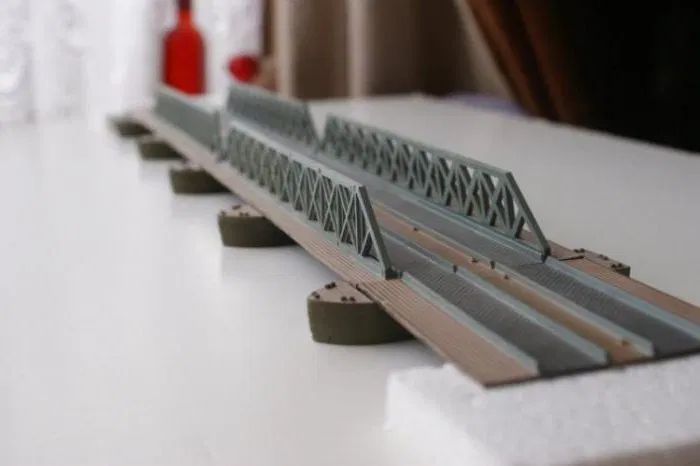
Permanent pontoon bridges are essentially exclusive structures, which make sense only for certain rare types of areas: especially deep water bodies, as well as water bodies with a very soft bottom, where the installation of supports would be impractical.
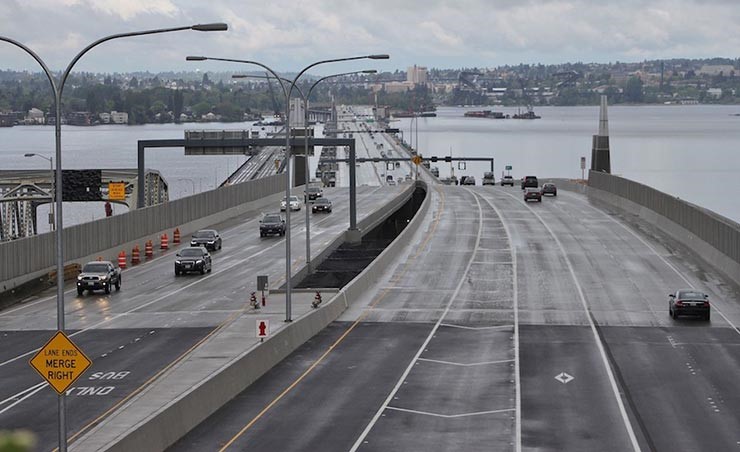
Evergreen Point Pontoon Bridge in Seattle, USA, length 2350 meters (pontoon section of the bridge), construction was completed in 2016. The six-lane bridge over Lake Washington is the state road SR 520 - from Seattle itself to its eastern suburbs. The bridge is supported by 77 concrete pontoons, which are attached to the bottom of the lake by 58 anchors tied to steel cables. The dimensions of each of the 21 pontoons, which hold the deck and span structure, are 110m x 23m x 8.5m, weight - 10,000 tons. And 44 additional pontoons, which are used to stabilize the weight of the bridge, have a mass of 2300 tons each. The deck at each end is connected to the fixed entrances to the bridge by two transverse pontoons, each weighing 9.200 tons, by means of hinges. The pontoons were designed by the Washington Department of Transportation, and the span structure was designed by KPFF. The bridge was built by a joint venture with Kiewit Corp., General Construction Co. and Manson Construction. Features of the relief of the lake - water depth of 61 m and 61 m of soft silt under it - served as an argument in favor of the pontoon bridge, as the usual would be too expensive, it would be necessary to build towers and large entrances to it, which would be too costly and completely inappropriate in an area where housing predominates. The cost of the construction was $ 4.5 billion. This bridge replaced the former four-lane pontoon bridge Evergreen Point, which was opened in 1963. Photo: Wikimedia Commons
The most active new projects of pontoon bridges are being studied in Norway, which is already the happy owner of the world's two longest bridges of this type. The E39 Coastal Highway, a large-scale project underway in the country, will include eight major crossings over water barriers. One of them, Bjornafjorden, is likely to become a pontoon bridge.«We recommend a pontoon bridge, but we have not yet decided whether it will be attached at the ends (like Bergsoysund and Nordhordland), or on all sides and with cables attached to the seabed (like pontoon bridges around Seattle),» says Eidem. Matthias Egeland, project manager for the construction of the crossing of the turn of the fjord in the Norwegian Department of Roads. - The great difficulty for the construction of a pontoon bridge with mounting on all sides, compared to the bridges near Seattle, is the depth. Near the bridge over the Hud Canal, the deepest anchorage is 120 meters below sea level, and the depth of Björnfjord is over 600 meters at the deepest point. The Norwegian Public Roads Administration (NADOP) has commissioned studies of both options.
«Firms such as Multiconsult ,as well as Johns Holt, NGI, Entail, Rambøll and Aker Solutions, conducted research on the pontoon bridge with mounting on all sides,» says Egaland, «while Norconsult, Dr.techn.Olav Olsen, NGI , Aker Solutions and Aas-Jakobsen considered a bridge with a fastening at the ends. The next step will be to further study these two concepts of pontoon bridges to make a final decision on the choice between them.»
All four of the longest pontoon bridges in the United States are located on the outskirts of Seattle. The oldest of them, the Lacey W. Marrow Bridge, was built on the project of progressive engineer Homer Hadley, who developed his idea after he had to build concrete barges during the First World War. He first proposed the idea at a meeting of the American Society of Civil Engineers in 1921, but it was rejected. In the following years, Hadley worked in the Association of Cement Firms. He eventually managed to persuade the Washington State Department of Highways to put his idea into practice. Construction of the first bridge using concrete pontoons was completed in 1940.
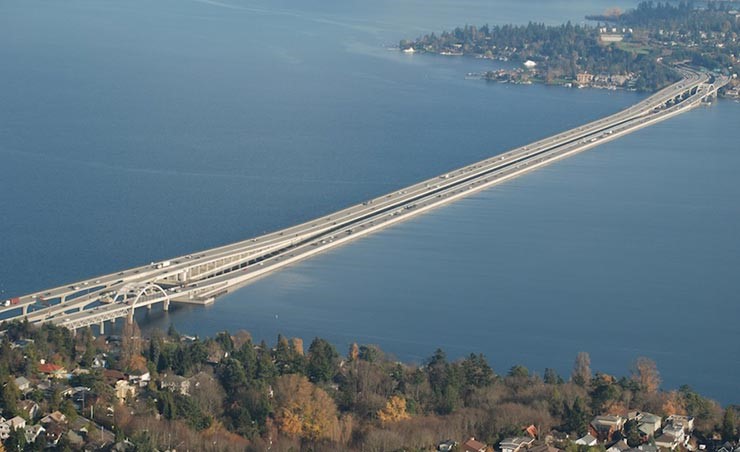
Lacey W. Marrow Bridge, Seattle, USA, 2020 meters, 1940. It runs through the eastbound lane of the federal highway Interstate 90 - through Lake Washington from Seattle, Washington, to Mercer Island, located in the same state. It is the world's first pontoon bridge to be built using concrete floating piers, designed by engineer Homer Hadley and built by Puget Sound Bridge and Dredging Co., and cost $ 9 million. During the reconstruction in 1990, a section of the bridge 850 meters long sank, as one of the pontoons was filled with water during a storm. The bridge reopened in 1993 after a $ 93 million overhaul. Photo courtesy of the Washington Department of Transportation
The terrain features of two water bodies located near Seattle are evidence in favor of pontoon bridges. "The depth of the water and the length of the open water are the main reasons why the Washington Department of Transportation decided to build pontoon bridges," said Steve Banquet, manager of the Information and Construction Communications Division of the Washington Department of Transportation. - Lake Washington is quite deep, 200 feet of water and beneath them 150-200 feet of soft quivering soil. The water depth in the Hood Canal in some places exceeds 300 feet. The length of the bridges across Lake Washington and the Hood Canal should be more than a mile. A bridge of traditional construction would require supports higher than a 40-storey building, and a suspension bridge like the one crossed over the Golden Gate would have to be made too massive to be lifted (suspended) above the water. To sum up: For the unique conditions of our region, the pontoon bridge is the most practical construction, both architecturally and financially.»
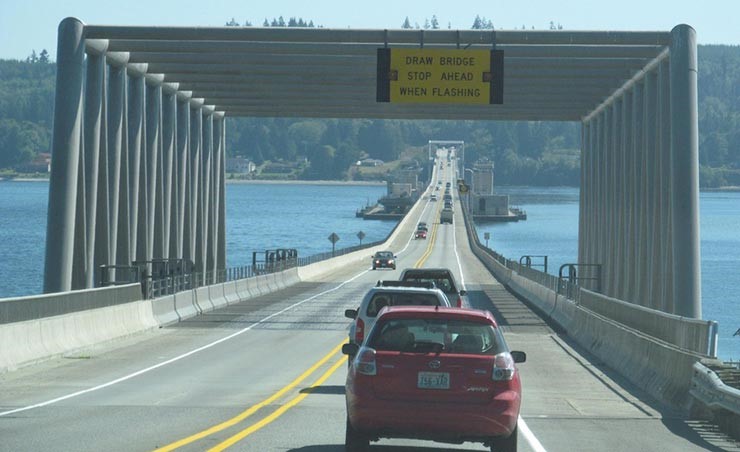
Bridge over the Hood Canal, USA, length 1988 meters, 1961. From this bridge, the state road SR 104 passes through the Hood Canal - a natural fjord that flows into the bay of Puget Sound. The bridge connected the shores of the Olympic and Kitsap peninsulas. The water depth in this area is from 24 to 104 m, and below it a few hundred feet of silt, so the construction of support columns for conventional bridges would be too expensive. In 1979, after a hurricane-force wind, several pontoons broke free and sank. The bridge was closed for repairs and resumed operations in 1982. From 2003 to 2009, the Washington Department of Transportation replaced the eastern half of the pontoon section of the bridge, the eastern and western access sections, the eastern and western transition sections, and the electrical equipment of the western half. 14 pontoons were manufactured at the Concrete Technology plant in Tacoma. Each pontoon consists of about 40 individual cells. Photo: Wikimedia Commons
The newest pontoon bridge in the region - Evergreen Point, the longest bridge of its kind in the world .Was opened in 2016. It replaced the previously existing pontoon bridge and has a higher capacity for transport. When designing the bridge, it was possible to run a high-speed tram on it in the future. To solve the problems with weather conditions and maintenance, the design team proposed to raise the deck of the bridge over the pontoons by 20 feet, which provides full access to all its systems from below. «This project was a difficult task because the pontoon bridge tends to bend and bend under the influence of load from traffic on it and environmental factors, so the span structure had to have strong enough joints to withstand these predicted displacements,»-says Michael. Abrahams, WSP USA Construction Technical Director.
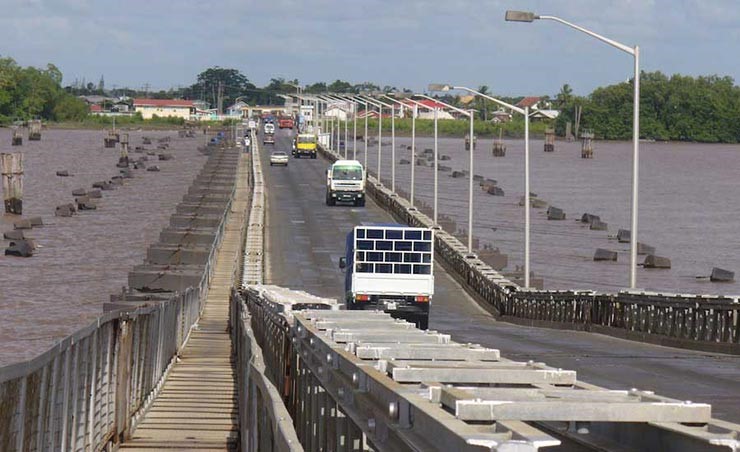
Demerara Harbor Bridge, Guyana, length 1851 meters, 1978. The bridge spans the mouth of the Demerara River in Georgetown, the capital of Guyana. The design and manufacture of bridge elements was performed by the British company Thos. Storey (Engineers) Ltd., which is known for the production of Bailey bridges. Guyana's Ministry of Transport and Public Works has developed a project for coastal pillars, a toll booth and a western access road. Now on the two-lane bridge the average of 14 000 cars a day passes. The capacity of the bridge is limited by the need to build it every day, opening traffic on the river, and the construction process is slow. The timing of the bridge opening also depends on the water level and the speed of the current (tidal wave), which often contradict the periods of maximum traffic intensity. The company-owner and operator of the bridge Demerara Harbor Bridge Corp. hired the Dutch company LievenseCSO, which is dedicated to the construction of hydraulic and coastal structures, to carry out the calculation and analytical substantiation and design of a new bridge over the Demerara River. Their report, which was presented in August 2017, states that the existing bridge "has long outlived its useful life" and is "no longer suitable for servicing current and future traffic flows." The company's recommendation is to build a new three-lane bridge with fixed supports. Photo: Wikimedia Commons
The Washington Department of Transportation intends to announce the passage of another key point after the existing Homer M. Hadley Bridge across Lake Washington is added to the tracks for high-speed tram. A difficult task for the transport company Sound Transit was the installation of rails on the bridge, during the construction of which folding connections were used to move from a rigid structure to a floating one, which can rise and fall by 2 feet depending on the water level. Having started working with a consulting group, led by the company now called WSP, the director of the British firm Andy Foan Ltd. Andy Fohen developed «rails with support on a curved element» - a winged curved platform in the place of two connections, where in a design of the bridge transition from rigid support to floating is carried out.
"WSP's design team has developed, analyzed and tested on prototypes (in full) a structure with curved elements, meets the technical requirements of Sound Transit for high-speed trams," says Abrahams. "It is a rail link with a smooth radius, which can be used in other areas, such as the construction of floating shipyards or railways in glacial or seismic zones." Construction is expected to begin this summer and be completed by 2020. Abrahams was also involved in the design of the only other comparable pontoon bridge in the United States, not located in Washington State - the Ford Island Bridge (otherwise known as Admiral Clare Bridge) in Hawaii. Abrahams explains that the fleet "needed a bridge across Pearl Harbor that would provide a low-level crossing, with minimal obstruction to the visual perception of the nearby Arizona battleship memorial, and the condition of a 650-foot navigable canal for aircraft carriers." The length of the bridge is 4,672 feet, the length of the pontoon section is 930 feet; construction was completed in 1998.
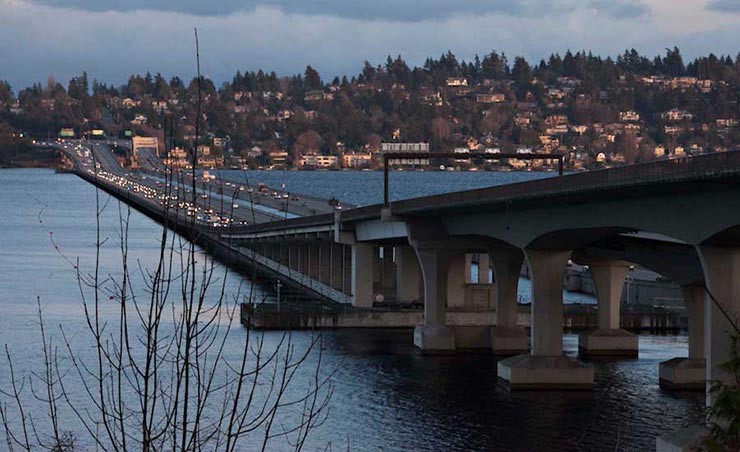
Gomer M. Hadley Bridge, USA, 172 meters, 1959. It runs from west to east on the federal highway Interstate 90 - across Lake Washington between Mercer Island Bridge, Washington, Seattle. The construction cost was $ 97 million. It is named after Homer Hadley, an engineer who designed the nearby Lacey W. Marrow Bridge. The design of the bridge includes 18 pontoons: 10 concrete and nine with a span structure on the hill. Photo courtesy of the Washington Department of Transportation . Options with pontoon bridges are being considered in several other countries where similar structures already exist. Representatives of the leadership of the Japanese city of Nagasaki are considering the construction of a pontoon bridge across the Gulf of Omura , which will be able to provide an additional route to the airport. Another possible project is a pontoon bridge across Lake Okanagan in Canada.
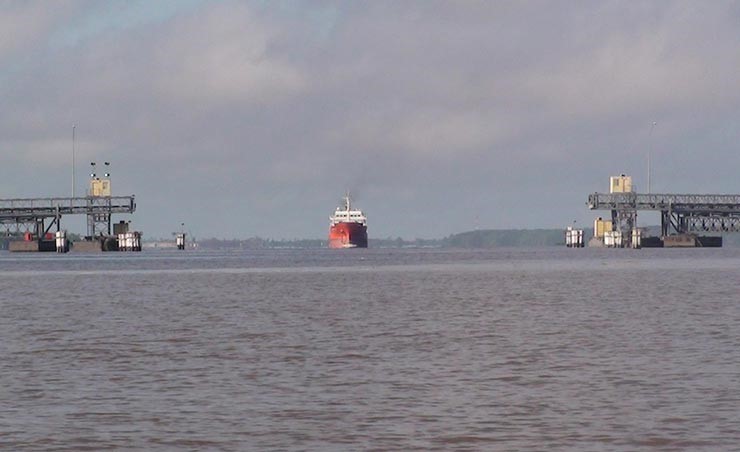
Berbice-Bridge, Guyana, +1571 meters, 2008. The bridge covers the mouth of the Berbice River and includes 39 pontoons. A consortium of Bosch Rexroth and Mabey & Johnson worked on its construction. The construction cost was $ 38 million. Every day the bridge is opened for 1½ hours for the passage of river transport. Cars are charged a travel fee of 2,200 Guyanese dollars ($ 10). Photo courtesy of Berbice Bridge Co. One of the distinguishing features of pontoon bridges is their maintenance needs. "They need more maintenance because of the rolling nature of such a bridge,"-said Nicholas Ryena, SNC-Lavalin's media relations officer. - The connection is affected by stronger movements due to the oscillations of the bridge. These movements lead to greater wearout of the joints during normal operation".
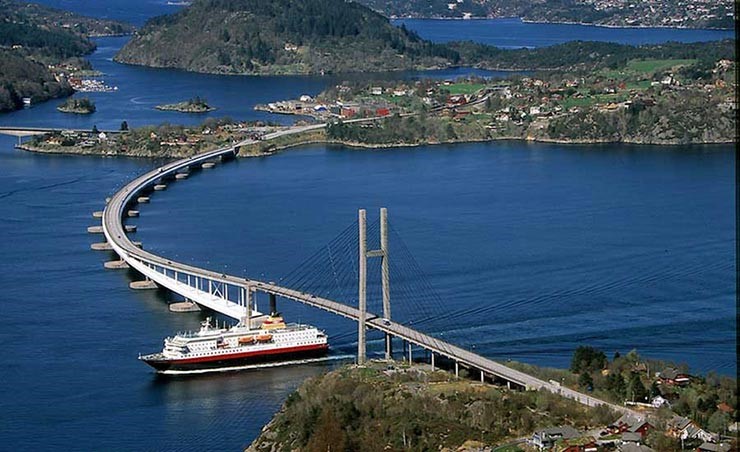
Nordhordland Bridge, Norway, 1,246 meters (pontoon section), 1994. This combined cable-stayed and pontoon bridge near the city of Bergen connects the Іsland Flatov with the mainland, crossing Salhusfjorden, which is 500 m deep. There are two lanes for cars and a path for pedestrians / cyclists. The floating section is a steel box superstructure on 10 concrete pontoons, each consisting of 9 watertproof cells. The project was created by Aas-Jakobsen. Given such a great depth of the fjord, the side fastening systems of the bridge would be too expensive. Instead, the pontoons are fixed by means of connections with flexible plates, bolts and stretched ropes. The bridge was built by the consortium Arbeidsfellesskapet Salhus Bru, which included the following companies: Norwegian Contractors, Aker Entreprenor, Veidekke and Kvaerner Eureka. Photo provided by the Norwegian Public Roads Administration.
Although permanent pontoon bridges have a strong reputation, their number is small, but temporary pontoon bridges are much more widespread, they are used both during military exercises and in civil emergencies. They were widely used during World War II by both Allied forces and EU troops, the most famous of which was built when US troops had to cross the Rhine after the destruction of existing bridges by retreating German troops.
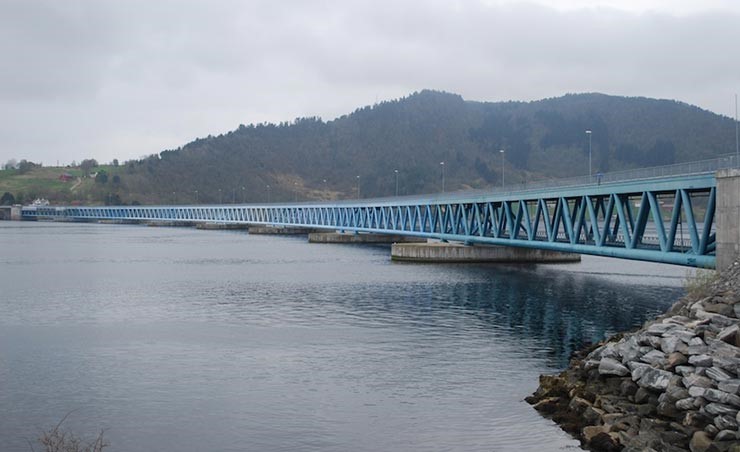
Bergsoysund Bridge, Norway, 933 meters, 1992. The bridge connects the islands of Aspoya and Bergsoya, crossing the fjord with a depth of 320 meters. Pontoons and shore supports were designed by engineering firm Johs Holt, steel span structure - by DNV Veritec. Concrete pontoons are made by Norwegian Contractors, truss span structure from steel pipes - Aker Verdal. The bridge leans on seven concrete pontoons. Photo provided by the Norwegian Public Roads Administration.
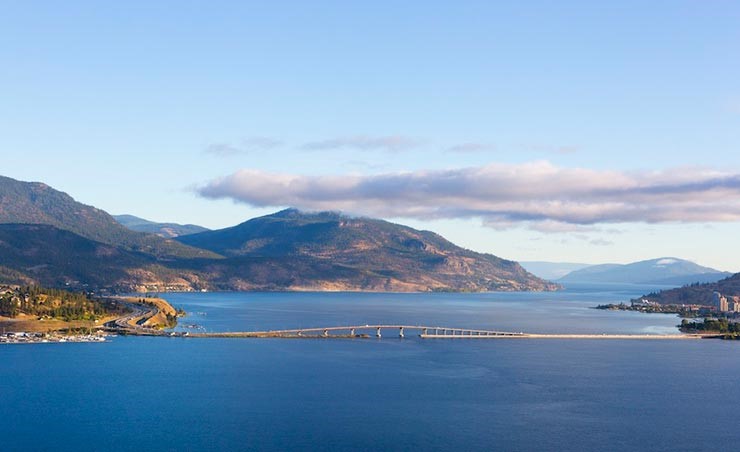
William R. Bennett Bridge, British Columbia, Canada, 690 meters, 2008. The design and construction of the bridge was carried out by SNC-Lavalin, which received a contract for its operation and maintenance for 30 years in the form of a public-private partnership. Buckland & Taylor Ltd. acted as the leading design firm. in partnership with SNC-Lavalin. The five-lane bridge is based on 9 pontoons, each of which is 25 m wide and their length varies from 25 m to 90 m. The construction cost 144.5 million Canadian dollars. The bridge replaced the three-lane bridge over Lake Okanagan, also a pontoon, which was built in 1958. According to SNC-Lavalin, among the many challenges the company faced during the project were: “a busy schedule, building a bridge in close proximity to an existing pontoon bridge and ensuring normal traffic during construction, providing labor through rapid market growth, the archeological area and the need for consultations with the indigenous population, as well as the dismantling of the existing bridge. " Photo courtesy of SNC-Lavalin.
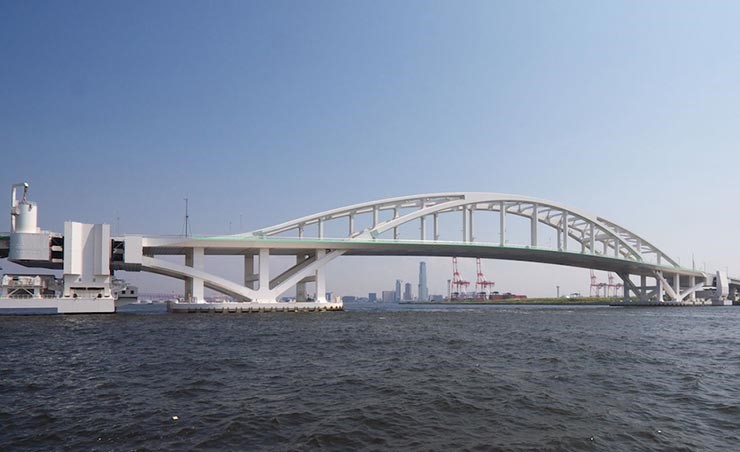
Yumey Bridge, Osaka, Japan, 410 meters. The world’s first floating pontoon bridge connects two artificial islands, Yumishima and Maisima, in the Osaka Bay. The design of the pontoon bridge was chosen because such an approach proved to be the most suitable for the soft ground of a drained area. The double arches of the bridge are supported by two large steel pontoons. The pontoons are designed to counteract corrosion by sheathing the sides with titanium plates and by having a cathodic protection system. The floating part of the bridge weighs 30,000 tons. The northern waterway it crosses is rarely used for passing ships, but when it does, the bridge is manoeuvred by tugs. Photo: Wikimedia Commons